












Welcome to The RARE Advisor. RARE stands for Recurring And Repeatable Events. Because when you have systems and processes in your business, that's when your business is the most predictable, that's when it will be worth the most, and that's when it will grow the most rapidly. Now, if you're interested, we have a new, free report called the 'Advisor's 12-Step Reset for Predictable Growth, Value & Lifestyle'. It's a smooth, 12-step process that I've uncovered and discovered over my 35+ year journey in this industry. And it's designed to generate a predictable practice with automated revenue and lifetime rewards.
With that being said, I want to chat today about something that you must eradicate from your business. Or, rather, that you should not allow to enter your business in the first place. And that can be a bit difficult given the fact that we've recently come off of a pandemic and what has historically been known as "The Great Resignation" - the byproduct of which is now being labeled as "The Great Gloom." Let's talk about what "The Great Gloom" actually is, and what it may represent.
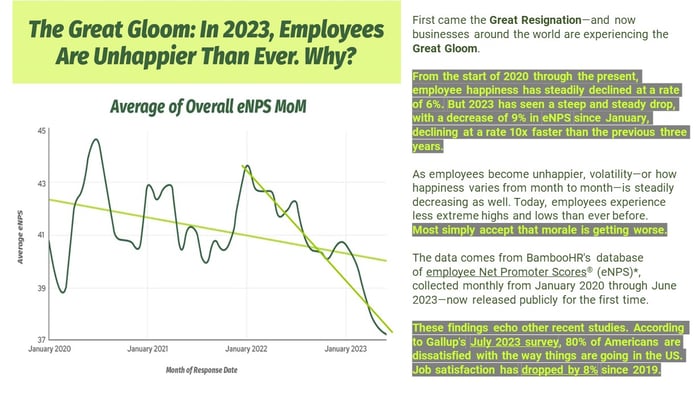 On the left of this image is the 'employee Net Promoter Score' scoring mechanism. You may be familiar with the Net Promoter Score, but if you're not you can learn more from this previous edition of RARE. But this image specifically references the employee version, where they actually ask employees to identify their "happiness" level. And what they're finding is the happiness level is dropping faster than it ever has before. In fact, it's dropping 10 times faster than it has in the previous three years. The reason I'm bringing this to your attention today is look what's been taking place since January of 2022. In less than two years, look what's happening to the trendline - it is dropping like a rock. And what they're actually seeing is that people are simply accepting that morale is getting worse in corporate America. These findings coincide with a large survey that Gallup did in July of 2023, where they said 80% of Americans are dissatisfied with the way things are going. And, on top of that, job satisfaction has dropped 8% on their record since 2019. So on the one hand, it's important understand this is taking place. On the other hand, the real question is: what does it mean? And how do you fix it?
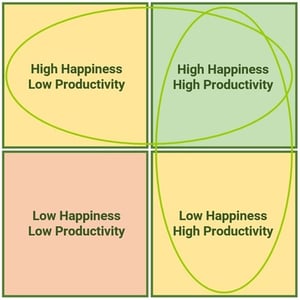
I'm going to switch you now to this four box matrix that isolates down to what I'll call happiness and productivity. Now, simply put, people (employees or otherwise) want high happiness. Companies (corporate America) wants high productivity. Obviously, the overlap is high happiness/high productivity. This is where you want to live.
How is it that happiness is dropping like a rock? And how does that correlate against the pandemic? Well, to take a very complex discussion and boil it down to its simplest terms, my contention is simply this: white collar workers, once they got a taste for remote work - working at home out of their spare bedroom, out of their den, out of their office - that's where they've wanted to stay. They've been digging in their heels, and they think that that is what they enjoy. The reality is, however, that people are built for community. When you isolate yourself down like that, and you're not having physical interactions - with your teammates, the people in your department, the people in your company, or even other companies - when you're not physically seeing each other and meeting each other, what's happening is that happiness is eroding. Interestingly, Zoom - the company that has promoted more than any other company the ability to have meetings/appointments by video, work remotely, and work through video - is trying to force employees back into their office. And they're having a hell of a time doing it. And so are many other companies. And it's because people are hanging on to this idea of remote work, even though it's working against the detriment of their happiness. Now, you would hope that people will eventually figure that out, and companies are figuring it out. But the problem is that as they're forcing people back to work, at best, they're going to end up in low happiness/high productivity. And if you have low happiness and high productivity, it's eventually going to slide into low happiness/low productivity. Nobody wants low happiness/low productivity. But right now, that's what people are afraid of - they're seeing low happiness. And companies will tell you, tracking some of their numbers, that maybe they're not having good productivity and they need to get the heck out of that quadrant. And their solution is that they're going to push people back to the office.
Now, my contention is that you're going to have a difficult time doing that in many instances, and I don't even necessarily recommend it. But what you do have to do is find some kind of happy medium. You have to find a way to keep people connected. And I don't think you can do it just through video. Because what happens in video, first of all, is great. It's better than just being on the phone. But it's still not a live meeting. That's one piece of it. The other thing that I think gets overlooked is the fact that if you're in a larger operation, you're having employees who might feel fairly connected to the people in their department. But, being remote, now they're having absolutely zero interaction with people in other departments. And yet, they rely on those people in those other departments, but they're never physically seeing them or interacting with them anymore. This is a huge challenge. This is going to affect the way your practice operates. This is going to affect the way the institutions you interact with operate. This is going to affect what's going on in terms of the value of the business and their ability to keep productivity levels up. And if they can't keep productivity levels up, what is that going to do their stock price? What does that do to the economy?
This is a phenomenon that was brought on by the pandemic. It would have taken us decades to get to this level of video interaction for meetings and appointments if it weren't for the pandemic. And now we're seeing the results of that happening. There have been some really positive results too, by the way. I love video meetings, I think they're super effective. They save you a ton of travel time. They can be way more effective than a traditional phone call. But they're still not the same as a live meeting and sometimes you need live meetings. So how do you combine these things? Find the right fit so your firm is not reflected by this downward trend. We don't want this to be your employees.
--
The RARE Advisor is a business model supercharged by Recurring And Repeatable Events. With more than thirty years of working with and coaching successful advisors, host Mike Walters (along with other leaders in the industry), discusses what it takes to grow a successful practice. With the aim of helping financial professionals and financial advisors take their business to the next level, Mike Walters shares insights and success stories that make a real impact. Regardless of the stage of your practice, The RARE Advisor will provide thoughtful guidance, suggestions for developing systems and processes that work, and ideas for creating an authentic experience for your clients.
The RARE Advisor is also a podcast! Subscribe today via Apple Podcasts, Google Podcasts, or your preferred podcast listening service for easier on-the-go listening.
Author Info
Mike Walters is the Chief Executive Officer (CEO) of USA Financial, leading the firm since its inception in 1988. Mike is committed to...
Related Posts
The Hiring Mistake That Can Stall Your Growth
When is the right time to make your next hire? Most advisors wait until they're overwhelmed, client service starts slipping, and their team is already operating at full capacity. In this episode of The Rare Advisor, Aaron Grady explores the difference between reactive hiring and intentional hiring, breaks down the key capacity signals advisors should watch for, and shares a practical framework for evaluating when hiring can unlock growth rather than simply relieve pressure. Learn how to identify bottlenecks, evaluate capacity, understand the economics of hiring, and position your firm for sustainable growth before a staffing crisis occurs.
The Invisible Expertise Problem Most Financial Advisors Face
What happens when a great financial advisor remains virtually invisible outside their current client base? In this episode of the Financial Advisor Marketing Playbook, Mark Mersman sits down with Gabe McManus of Influential Advisor Media to discuss how advisors can transform expertise into influence through books, storytelling, podcast guest appearances, and authority-building content. They explore the role of authentic communication, AI, podcast marketing, personal branding, and the strategies advisors can use to become more visible without turning into full-time influencers.
Stop Solving Every Problem for Your Team
Many financial advisors become the default answer machine inside their firms without even realizing it. In this episode of The RARE Advisor, Aaron Grady introduces the 1-3-1 Exercise, a simple leadership framework designed to help advisors develop stronger problem-solvers, better decision-makers, and more independent team members. Learn how one problem, three possible solutions, and one recommendation can transform everyday challenges into opportunities for leadership development, ownership, and long-term team growth.