





















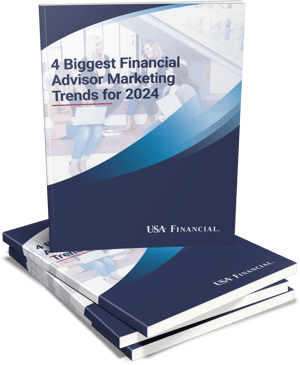
Last year, we explored four major marketing trends for 2025: authentic storytelling and personalization, marketing automation and AI, video content, and virtual appointments. These weren't just passing fads—they've become foundational elements of successful marketing strategies. But as we move into 2026, new opportunities are emerging that build on this foundation.
The question isn't whether to adapt, but how to adapt strategically. The most successful advisors aren't trying to do everything. They're identifying which trends align with their practice's strengths and their clients' needs and then executing those strategies with excellence.
This guide highlights five key trends that deserve your attention in 2026. They're organized into three categories that represent the full spectrum of modern marketing: AI-related trends that help you work smarter, digital trends that expand your reach and influence, and human-centered trends that deepen relationships and build trust.
Paying attention to these trends and learning which ones to embrace is critical to your success, regardless of whether you're the new firm on the block or the seasoned and mature practice in your community.
AI-Related Marketing Trends
Trend #1: AI-Powered Personalization at Scale
We've moved far beyond basic personalization like inserting a client's first name into an email. Today's clients expect you to understand their unique circumstances, goals, and preferences, and they expect you to demonstrate that understanding in every interaction. The challenge? Delivering this level of personalization to dozens or hundreds of clients would be nearly impossible without help. That's where AI comes in.
The data on AI-powered personalization is compelling. According to recent research, financial advisors leveraging generative AI for personalization are experiencing five times more leads and doubled conversion rates. This isn't just about efficiency—it's about delivering experiences that truly resonate with each individual client or prospect. Technology can analyze patterns in client behavior, predict needs before they arise, and help you reach out at exactly the right moment with the right message.
This builds on the marketing automation tools we discussed last year (like FMG Suite) but takes them to the next level. While those platforms help you "set it and forget it," AI-powered personalization actively learns and adapts to each client's unique preferences and behaviors.
Key AI Strategies for Advisors
Here are some specific ways you can put AI-powered personalization to work in your practice today:
Predictive Lead Scoring & Prospect Identification: Tools like Finny use AI to analyze vast amounts of data and generate hyper-curated lists of prospects who match your ideal client profile. The real power isn't just in identifying these prospects, it's in the automated outreach campaigns you can build from these lists. Instead of manually researching prospects and crafting individual outreach messages, AI handles the heavy lifting: identifying high-potential prospects in your area, building targeted lists based on specific criteria (wealth indicators, life events, demographics), and enabling you to launch personalized campaigns at scale. This allows you to focus your energy on the conversations that matter rather than the prospecting grunt work.
Personalized Content Delivery: AI can help you deliver the right message to the right person at the right time, but you don't need sophisticated enterprise software to get started. Many modern email marketing platforms and CRM systems now include AI-powered features that can recommend which content to send to which clients based on their interests, behaviors, or life stage. Even simpler approaches work using your CRM to tag clients by key characteristics (retirees, business owners, young families) and sending targeted content to each segment. The goal is to move beyond one-size-fits-all newsletters to communications that feel relevant and personal to each recipient.
Intelligent Outreach Timing: AI-powered systems can analyze when clients are most likely to engage with your communications and automatically send emails or schedule touchpoints at optimal times. They can also identify life events or behavioral signals that suggest a client might need specific services, enabling you to reach out proactively rather than waiting for them to contact you. Many CRM platforms offer suggestions on optimal send time based on previous engagement. So, even without advanced AI, you can use your CRM's reminders and workflows to ensure timely follow-up based on important dates or milestones.
The Bottom Line
AI doesn't replace you as the advisor—it amplifies your ability to serve clients personally. By automating the data analysis and pattern recognition, you free up time to focus on the relationship-building and strategic advice that only humans can provide. The firms winning in 2026 are those using AI to work smarter, not just faster.
Take a moment to reflect: Could AI help you identify which prospects deserve more of your time? Could automated personalization help you stay connected with clients in meaningful ways without overwhelming your schedule? The technology is here, and it's more accessible than ever.
Trend #2: Generative Engine Optimization (GEO) & Answer-Engine Optimization (AEO)
Think about how you search for information today versus a few years ago. Chances are, you're increasingly turning to AI assistants—ChatGPT, Google's AI Overviews, Claude, or similar tools—more often than typing keywords into Google. Your prospective clients are doing the same thing. And when someone asks an AI assistant "Who's a good financial advisor for tech professionals in my area?" or "How should I plan for early retirement?", AI tools don’t just pull a list of links—they generate answers. That’s a big shift.
Related Posts

14 LinkedIn Marketing Tips for Financial Advisors
With over 1.2 billion members worldwide as of 2026, LinkedIn isn't just another social network—it's the world's largest professional networking platform. We're talking about a platform where 40% of active users check the platform daily, creating consistent opportunities for meaningful engagement.

How Financial Advisors Can Use AI to Support Their Business
In today’s rapidly evolving business landscape, technology has become a powerful catalyst for innovation. Artificial intelligence (AI) is revolutionizing industries with automating tasks and providing enhancements to processes which have unlocked new opportunities. AI-powered technology, for instance, is transforming traditional support roles, providing businesses with tools that can improve workflow efficiency and strategic capabilities.

Is Your Brand Working for You?
In today's competitive landscape, your advisory firm is more than just a name. It's your promise, your reputation. But how do you know if your brand is working for you, attracting the right clients, and communicating your value effectively? The answer lies in a brand audit.