






















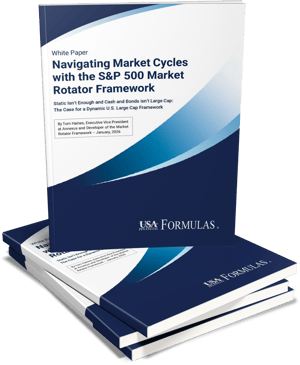
Recently, the widely followed market capitalization weighted S&P 500 Index has been the dominant investment style and even more specifically the largest ten underlying growth stocks within the S&P 500 have been the contributing leaders. However over long periods of history a perpetual market capitalization weighted S&P 500 allocation has demonstrated extended periods of risk and underperformance. The strategies that triumph in one economic regime often struggle in the next, leaving static portfolios vulnerable to prolonged periods of underperformance.
This paper offers a comprehensive look at how different S&P 500 weighting styles - Cap Weighted (S&P 500), Equal Weighted (EW), and Low Volatility (LV) - have cyclically taken turns leading the market. More importantly, it introduces the S&P 500 Market Rotator Index, a forward-thinking solution designed to systematically adapt to these shifts, offering a more resilient and potentially superior U.S. large cap allocation framework.
In this white paper, we will explore:
-
Why a U.S. large cap core allocation should always be invested in stocks.
-
A review of Cap Weighted, Equal Weighted, and Low Volatility S&P 500 styles.
-
A historical journey through decades of market performance, revealing why different styles excelled in different eras.
-
The powerful role of narrative and simplicity in driving investment decisions, often overshadowing complex factor models.
-
The design and conceptual performance of the S&P 500 Market Rotator Index, created to capture leadership shifts and enhance long-term outcomes.
Related Posts
What's Trending: Three Numbers Defining the September Market Right Now
In this September edition of The Trending Report, Tyler Krzciok breaks down three key numbers shaping today's market environment: the S&P 500's year-to-date return, current Treasury yields, and the trillions of dollars sitting in money market funds. He also examines improving market breadth, what it means when gains begin spreading beyond a handful of large technology companies, and why investors should separate market signals from seasonal headlines. Plus, Tyler tackles the so-called "September Effect" and explains why disciplined investors should focus on fundamentals rather than calendar-based market fears.

What's Trending: How Back-to-School Spending Impacts the Stock Market
In this August episode of the Trending Report, host Tyler Krzciok examines one of the biggest seasonal economic drivers of the year: back-to-school and college spending. With consumers projected to spend nearly $147 billion on school supplies, electronics, dorm furnishings, apparel, and more, August serves as an important indicator of consumer confidence and economic health. Tyler Krzciok explores how this annual spending surge impacts major retail sectors, influences investor sentiment, and creates opportunities across technology, home goods, and consumer retail stocks.
What's Trending: 250 Years of American Culture and Market History
As America celebrates its 250th anniversary, this July episode of The Trending Report takes a fascinating journey through the nation's cultural and financial evolution. From the penny press and canal stock speculation of the 1800s to the rise of television, social media, and artificial intelligence, Tyler Krzciok explores how technological innovation has consistently transformed both pop culture and the stock market. Discover the recurring patterns that connect major cultural shifts, investor behavior, market booms, and historic downturns—and learn why understanding these long-term trends can help investors maintain perspective in today's rapidly changing world.